
The time is now! Sign up for 2026 San Antonio Combat PTSD Conference, premier meeting on military psychological health
STRONG STAR NewsAugust 21, 2026
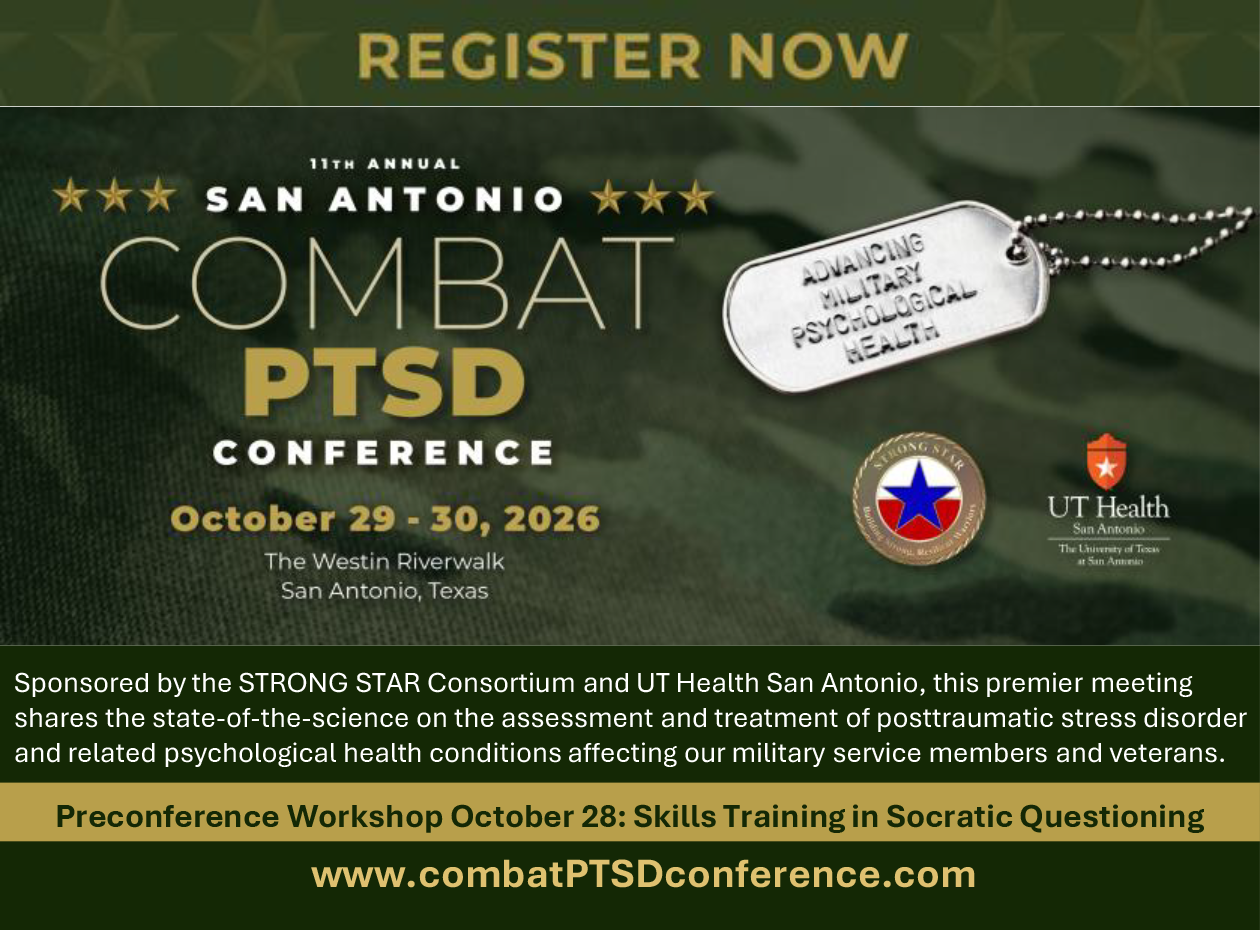
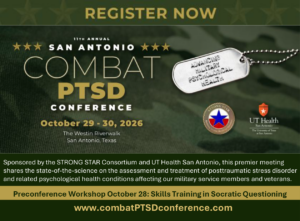
With registration underway, it’s time to grab your spot at the 11th Annual San Antonio Combat PTSD Conference, to be held Oct. 29-30 in downtown San Antonio at The Westin Riverwalk. Recognized as the premier scientific gathering on military psychological health, the popular event is expected to attract high attendance for its two-day conference, as well as for a pre-conference workshop on Oct. 28 that will offers skills training for clinicians, so people are advised to register early. The annual gathering is put on by the STRONG STAR Consortium and UT Health San Antonio, the academic health center of The University of Texas at San Antonio. Each year, it attracts an international audience that includes researchers, clinicians, leaders and policy makers within the Department of War and the Department of Veterans Affairs as well as from academic institutions and the civilian sector. Numerous military personnel, veterans and community members with an interest in the mental health needs of …
Healthy SA: PTSD is a treatable condition that anybody can suffer from
KENS 5July 29, 2026
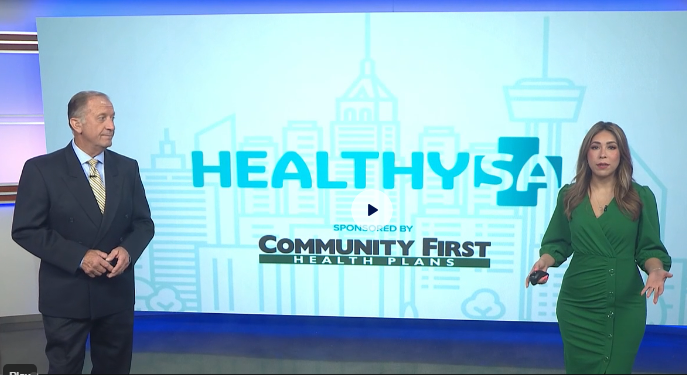
At some point in our lives close to one in 10 of us will experience some form of post-traumatic stress disorder. But as KENS-TV’s Jeremy Baker explains after talking with STRONG STAR Director Dr. Alan Peterson, PTSD doesn’t have to run your life. It can be managed so you can go on living.
San Antonio could get psychedelic drug clinical trials to help treat veterans
San Antonio ReportJuly 16, 2026
San Antonio Mayor Gina Ortiz Jones has asked VA Secretary Doug Collins that the city be considered as a site for future VA clinical trials testing psychedelics for the treatment of veterans with post-traumatic stress disorder. In a conversation with the San Antonio Report, Dr. Alan Peterson discussed the heightened national interest in psychedelics and how, thanks to leadership shown by the STRONG STAR Consortium at UT Health San Antonio in the field of combat-PTSD research, including with psychedelics and other innovative therapies, Military City USA is well positioned to work with the VA in this area. The research is needed, he says, to evaluate the true risks and benefits of psychedelics and how best to incorporate them into evidence-based treatment approaches.
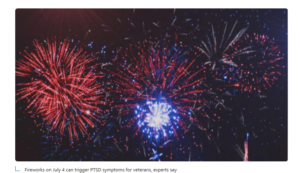
Experts offer tips for handling fireworks with PTSD
KENS 5July 2, 2026
Fireworks are usually seen as a harmless form of entertainment and celebration, but for those affected by trauma, the displays can trigger physical and mental responses that can be extremely distressing, especially for veterans. STRONG STAR Director Dr. Alan Peterson talks with Jeremy Baker of KENS-TV about what to do for those affected as we near the July 4th weekend and 250th anniversary of our nation’s founding.
Focus on South Texas: Understanding PTSD with UT Health San Antonio
FOX-SA/KABB-TV - Focus on South TexasJune 28, 2026
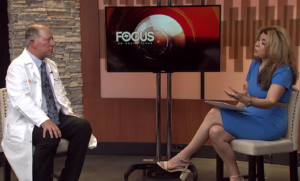
STRONG STAR Director Dr. Alan Peterson of UT Health San Antonio joined KABB’s “Focus on South Texas” to share information about posttraumatic stress disorder during PTSD Awareness Month. He and host Melissa Vega discussed what PTSD is, what can cause it, how to recognize it, and what to do if you or a loved one needs help.
Brain stimulation can help PTSD symptoms, studies find
Spectrum NewsJune 25, 2026
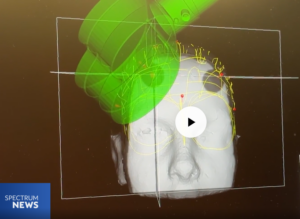
June is PTSD Awareness Month. There are approximately 13 million people suffering with post-traumatic stress disorder in the U.S. — and up to half of them do not experience meaningful symptom relief from existing treatments. This story by Spectrum News highlights the promise of brain stimulation, specifically through transcranial magnetic stimulation (TMS), in alleviating symptoms. The news story reports on successful trials by researchers at Emory University with civilians and by UT Health San Antonio researchers with active duty military personnel and veterans.
Science & Medicine: MDMA could revolutionize PTSD treatment for the military
Texas Public RadioJune 8, 2026
Could adding the mood-altering drug ecstasy to psychotherapy help people in the military who’ve been diagnosed with post-traumatic stress disorder recover in just two weeks? Alan Peterson, PhD, professor of Psychiatry and Behavioral Sciences at The University of Texas at San Antonio (UT San Antonio) Long School of Medicine, thinks it could, and he’s preparing a study to test that theory. “We believe these medications will increase your neuroplasticity so that you can fully benefit from the therapy that you’re pursuing,” Peterson explained. He is the director of the STRONG STAR Consortium, a national research network focused on identifying the best prevention and treatment for psychological health issues affecting military members, veterans, and first responders.

Alan Peterson on Unexpected Opportunities: NSU Commencement 2026: Business, Computing, & Psychology
Nova Southeastern University YouTubeMay 11, 2026
Speaking at commencement ceremonies for his alma mater, Nova Southeastern University, STRONG STAR Director Alan Peterson, PhD, advised graduates to seize unexpected opportunities that come in their lives. Recounting his own experiences in life, from working with his mentor at NSU to his first military deployment on Sept. 11, 2001, to figuring out how to treat PTSD in a combat zone, to the formation of the STRONG STAR Consortium, he showed how both unexpected challenges and experiences in life can be opportunities to grow and to make our mark on the world. Sharing his own hard-earned life lessons, Dr. Peteron called upon new graduates to seize the “unexpected opportunities,” be entrepreneurial, and remain optimistic, leveraging stress to their advantage to achieve their vision. “Optimism is a force multiplier,” Dr. Peterson shared, urging grads to never stop believing in themselves.
Science & Medicine: For veterans with traumatic brain injuries, AI offers a new weapon against post-traumatic headaches
Texas Public RadioMay 10, 2026
Don McGeary, PhD, a professor with UT Health San Antonio and STRONG STAR collaborator, speaks with Texas Public Radio’s Bonnie Petrie in a recent episode of the “Petrie Dish” to discuss advances in treating chronic headaches following a head injury, such as a concussion. He and his team already have shown great success with a cognitive behavioral therapy they designed specifically for post-traumatic headaches, with clinical trials showing the therapy significantly reduces headache disability and commonly co-occurring post-traumatic stress. He believes the benefits could be even greater with more personalized treatment, so he’s training an artificial intelligence machine learning model to, among other things, help patients better predict their headaches so they can take advance steps to avoid or better cope with them.
A San Antonio veteran’s search for relief led him to a psychedelic drug in Mexico
San Antonio ReportMay 3, 2026
Amid the national attention on the study of psychedelics in treating posttraumatic stress disorder and other psychological health conditions affecting military service members and veterans, this story by the San Antonio Report examines the potential risks and benefits through the personal story of veteran Brian Mosely. Alan Peterson, PhD, a clinical psychologist at UT Health San Antonio and director of STRONG STAR, tells the San Antonio Report that he sees potential in using psychedelics like ibogaine and MDMA in treating PTSD, but as complements to established psychotherapy treatment such as Prolonged Exposure.